
Freeing the Bee
And my Self-Created Mess

This morning during my meditation, I heard a loud buzzing. Housefly? No, it sounded more powerful, so I opened my eyes to spy a bee desperately flying against my ceiling, zigzagging in futile loops searching for a way out.
I interrupted my meditation and opened the bottom half of the window, raising the screen to give him access.
Buzzzzzzzzzzz
Finally, with a minute and a half to go, I aborted meditation and did the dharmic (right action) thing: I got the stepladder, climbed up to the enormous 36-year-old hanging Evolvulus that is half-dead but will come back with pruning and has long-needed to be taken down for surgery, and in doing so, I pulled most of the other plants down because they were entangled in the dead stems.
Surrounded by fallen plants and pots, I laughed.
Then I disentangled everything, took the Evolvulus to the tub, leaving a trail to the bathroom of broken leaves, stems, dirt, and pot chards. Then I walked back through my now woodland carpet and opened the top half of the window.
I sat . . . I tracked the now-insane bee, trying to telepathically urge him into the wide-open air.
It took a while, but eventually he flew out. I closed the window and am now staring at the mess.
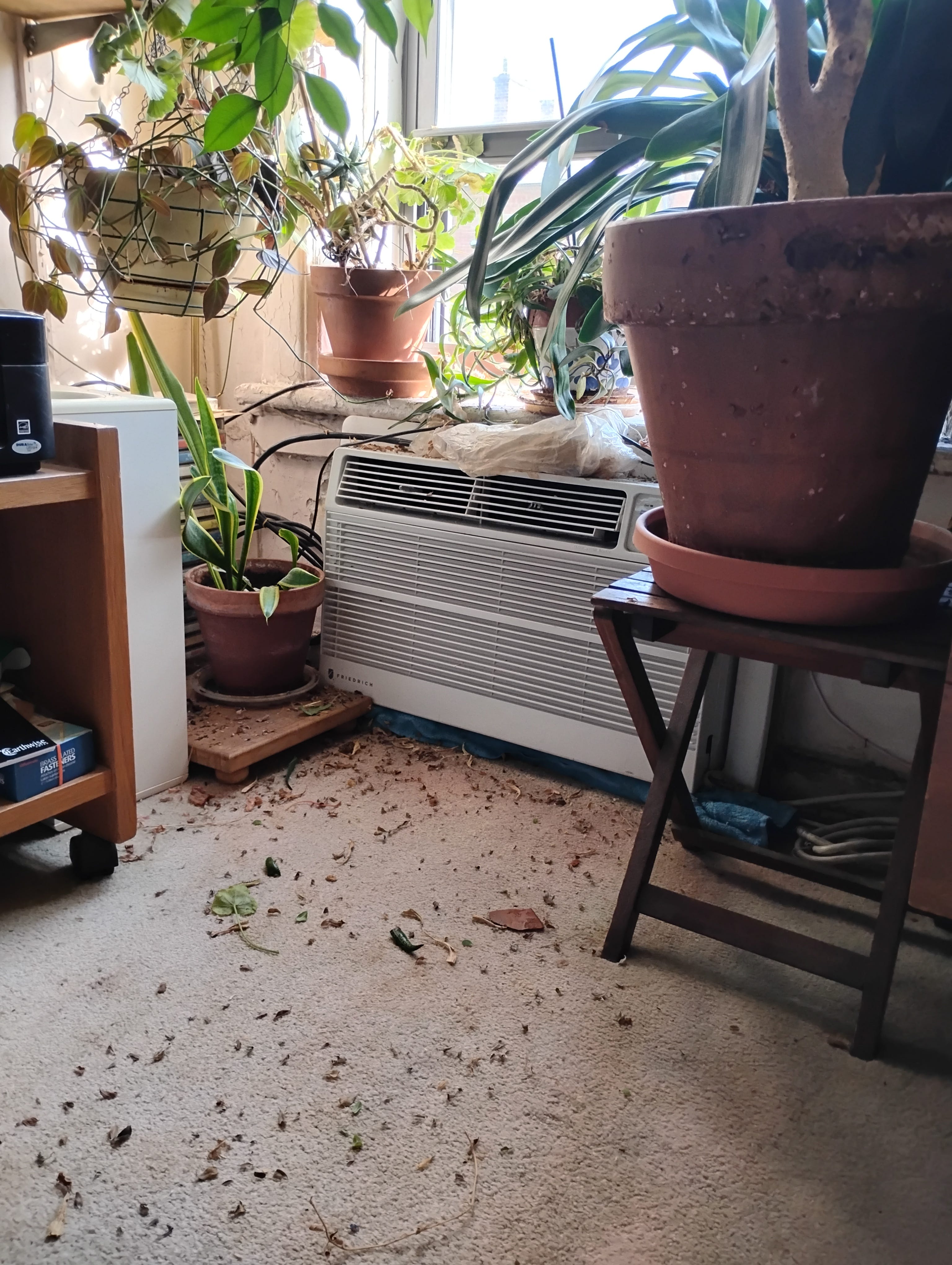
I will clean it up. But first I must look at it.
Apparently, this was what was necessary to free the bee. The open access was right there, but it was too low with only the bottom half of the window open. The bee was flying high and didn’t even think to go low, ignoring the currents below him.
So, for both our well-being, I decided to go high.
Going high wreaked havoc. There was no way I could have avoided it with an enormous half-dead plant entangled in everything below it.
“The access is right there,” I’d thought-yelled to the bee, but he couldn’t hear me.
So I, in the role of room-overseer, did what I had to do to free him.
I will soon clean up the mess, prune the Evolvulus (given to me by a plant-loving colleague when I worked nights as a legal secretary—thanks, you-know-who; it’s still thriving!). And I will go on.
This is a parable . . . in case it isn’t obvious.
Postscript
To get the most out parables, I think it’s helpful to see them through to the end . . . or as close to the end as is visible.
I pruned the Evolvulus, rehung it, picked up some of the dead stuff by hand, and as I plugged in the vacuum cleaner to begin the final cleanup, I flooded with profound sadness.
I believe this sadness is part of upheaval and transformation. And part of us knows it even before the upheaval, so we squirm and pretzel ourselves to avoid getting anywhere near it. Some of us run at the first sign of upset. We just want a clean, orderly life where nobody makes a mess.
It is not possible.
I understand this sadness and will allow it to pass through me—neither clinging to it because of the “high drama” of pain, nor obsessing over its "meaning," nor ignoring it. This sadness is a product of the alchemy of change, and I am committed to change.
Betsy Robinson is an editor, fiction writer, journalist, and playwright (also a former actor). She has written about books for Publishers Weekly, Lithub, Oh Reader, and many other publications. Her novels Cats on a Pole and The Spectators were published by Kano Press in 2024. She writes funny stories about flawed people and examines our herd culture. www.BetsyRobinson-writer.com.
oh my ... great story ... great parable ... I see it and hear it loud and clear!! Thank you!
What a wonderful story. Thank you!